| 0 comments ]

A question that I frequently receive is if there is a difference in virtual machine performance if the virtual machine is created with multiple cores instead of selecting multiple sockets?

Single core CPU 
VMware introduced multi core virtual CPU in vSphere 4.1 to avoid socket restrictions used by operating systems. In vSphere a vCPU is presented to the operating system as a single core cpu in a single socket, this limits the number of vCPUs that can be operating system. Typically the OS-vendor only restricts the number of physical CPU and not the number of logical CPU (better know as cores).

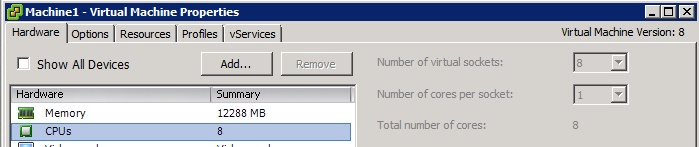
For example, Windows 2008 standard is limited to 4 physical CPUs, and it will not utilize any additional vCPUs if you configure the virtual machine with more than 4 vCPUs. To solve the limitation of physical, VMware introduced the vCPU configuration options “virtual sockets” and “cores per socket”. With this change you can for example configure the virtual machine with 1 virtual sockets and 8 cores per socket allowing the operating system to use 8 vCPUs.

Just to show it works, I initially equipped the VM running Windows 2008 standard with 8 vCPU each presented as a single core.

| 0 comments ]

Purpose

This article provides information on the concepts, limitations, and some sample configurations of link aggregation, NIC Teaming, Link Aggregation Control Protocol (LACP), and EtherChannel connectivity between ESXi/ESX and Physical Network Switches, particularly for Cisco and HP.

Resolution

Note: There are a number of requirements which need to be considered before implementing any form of link aggregation. For more/related information on these requirements, see ESXi/ESX host requirements for link aggregation (1001938).

Link aggregation concepts:
  • EtherChannel: This is a link aggregation (port trunking) method used to provide fault-tolerance and high-speed links between switches, routers, and servers by grouping two to eight physical Ethernet links to create a logical Ethernet link with additional failover links. For additional information on Cisco EtherChannel, see the EtherChannel Introduction by Cisco.
  • LACP or IEEE 802.3ad: The Link Aggregation Control Protocol (LACP) is included in IEEE specification as a method to control the bundling of several physical ports together to form a single logical channel. LACP allows a network device to negotiate an automatic bundling of links by sending LACP packets to the peer (directly connected device that also implements LACP). For additional information on LACP see the Link Aggregation Control Protocol whitepaper by Cisco.

    Note: LACP is only supported in vSphere 5.1, using vSphere Distributed Switches (VDS) or the Cisco Nexus 1000v.

  • EtherChannel vs. 802.ad: EtherChannel and IEEE 802.3ad standards are very similar and accomplish the same goal. There are a few differences between the two, other than EtherChannel is Cisco proprietary and 802.3ad is an open standard.
  • For additional information on EtherChannel implementation, see the Understanding EtherChannel Load Balancing and Redundancy on Catalyst Switches article from Cisco.

| 1 comments ]

Loạt bài về vSphere 5 :
1. Cài đặt VMware vSphere ESXi 5
2. Cài đặt VMware vSphere Client 5.0
Bài viết này sẽ hướng dẫn cài đặt vCenter.
Tôi copy lại 02 bài về vCenter & vSphere Client của congdd để bổ sung vào loạt bài về vSphere 5, sử dụng sơ đồ mạng ở trên.
∞&∞

| 0 comments ]

Cài đặt VMware vSphere ESXi 5
Nghiên cứu vSphere cũng đã khá lâu, cũng có viết một số bài lab nhưng chưa publish lên. Thôi thì hôm nay dành ít thời gian để đăng tải loạt bài về VMware vSphere ESXi 5 lên blog, để nó mốc meo lâu quá rồi ^^!
Mô hình mạng sẽ sử dụng trong các bài lab sắp tới như sau :
Trong bài này, Tôi sẽ viết về quá trình cài đặt ESXi 5 và giới thiệu tổng quan một số thông tin, tùy chọn trên phiên bản ESXi 5.


| 0 comments ]


∞&∞

| 0 comments ]